

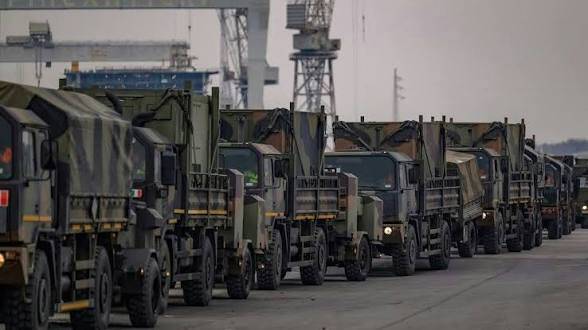
NATO, or its full name, the North Atlantic Treaty Organisation, is a military and political alliance made up of 32 nations spanning Europe and North America. NATO, having been founded in 1949, was created to provide collective defence for its members against the perceived threat of the Soviet Union at the time. Since then, it has become the largest military alliance in the world. But what does NATO actually do, and how does it protect Europe and North America from war with Russia?
At the core of NATO is the idea of collective defence against external threats, set out in Article 5. It states that an armed attack against at least one NATO member is considered an attack against every NATO country. This means that once Article 5 is invoked, every member has an obligation to assist the country under attack. There is a but, however: the activation of Article 5 does not mean every country must deploy combat troops. Instead, each country can take whatever action it considers necessary to help. The principle of Article 5 is to deter potential attackers such as Russia by clearly outlining that an attack on one NATO member is an attack on all.
NATO’s collective defence under Article 5 is supported by the various capabilities of its members. The alliance does not rely on one army, but instead every nation provides its own armed forces and specialist capabilities to support NATO. These capabilities can include fighter jets, ground forces, naval assets, air defences, ammunition, intelligence and nuclear deterrence. The UK specifically is one of only three NATO countries to have nuclear weapons, alongside the US and France. The UK and France both contribute their independent nuclear deterrents to NATO’s overall deterrence, while the US provides the main nuclear guarantee for the alliance. On top of this, NATO often conducts large military exercises, an example being Exercise Steadfast Dart 26, which took place between January and March 2026, bringing over 10,000 troops from across NATO together. Some NATO members also keep troops in other countries, particularly on NATO’s eastern flank. For example, the UK has around 800 troops in Estonia, with plans to increase this to 1,200 troops from April 2027.
While NATO has 32 members, decisions are not made by one powerful country alone. Instead, NATO operates on the principle of consensus. This means that all countries must agree before deploying or authorising NATO operations or missions. But where are the decisions made? The decisions are made by the North Atlantic Council, where there are representatives from all 32 NATO countries who meet to discuss security issues and how NATO will respond to them, if at all. All of this means that NATO’s response to a crisis is based on what every nation in NATO believes is the right course of action to take, rather than simply being controlled by one country.
Overall, NATO was designed from its very origins to deter an attack. It is a defensive alliance meant to ensure the safety of Europe and provide collective defence if an attack ever occurs. Through Article 5, regular exercises, forces stationed across Europe and the individual military capabilities of each country, NATO aims to deter an adversary from attacking any member country while ensuring that, if an attack ever were to happen, it would be costly for the aggressor. Russia’s invasion of Ukraine in 2022 demonstrated the need for NATO members to spend more on defence, as security in Europe became more uncertain. This led NATO members to commit to increasing defence spending, with at least 3.5% of their respective GDPs going towards core defence requirements by 2035, alongside up to a further 1.5% on wider defence and security-related spending. This represents a major increase in defence investment compared with previous NATO commitments. While NATO’s main goal is to deter war, it cannot ensure that a war will never happen. Its purpose is to make clear that, if an attack ever were to happen, NATO members would work together to protect their collective security.
Made by JS
Sources
NATO — Collective Defence and Article 5
https://www.nato.int/en/what-we-do/introduction-to-nato/collective-defence-and-article-5
NATO — Exercise Steadfast Dart 26
https://www.nato.int/en/multimedia/multimedia/photos/2026/02/25/exercise-steadfast-dart-26-showcases-natos-rapid-reinforcement-and-the-allied-reaction-force
NATO — Nuclear Deterrence
https://www.nato.int/en/what-we-do/deterrence-and-defence/natos-nuclear-deterrence-policy-and-forces
NATO — Consensus Decision-Making
https://www.nato.int/en/what-we-do/introduction-to-nato/consensus-decision-making-at-nato
NATO — North Atlantic Council
https://www.nato.int/en/about-us/organization/nato-structure/north-atlantic-council-nac
NATO — Defence Expenditure and 5% Commitment
https://www.nato.int/en/what-we-do/introduction-to-nato/defence-expenditures-and-natos-5-commitment
UK Government — UK and Estonia Defence Roadmap
https://www.gov.uk/government/news/european-security-strengthened-under-landmark-uk-and-estonia-agreement
Image from NATO operation steadfast
Add comment
Comments